Credo: Why We Built Pioneering Deep Tech Institute
Why we built Pioneering Deep Tech Institute — a founder-aligned deep-tech incubator that keeps ownership with the builders. Andrew Piskadlo on stewardship over extraction, the cycle we're breaking, and the first company that proved the model. Utah 501(c)(3) since 2022. Concept to MVP in 12-18 months. No IP capture.
The mentor and the bargain
When I was 19, I worked at a science laboratory at Westminster College as an assistant lab manager. The job paid minimum wage. I worked 80–100 hour weeks. The institution required that I log only 40. The overtime was verboten, the work was not, and the mentor I had then taught me everything from hazardous-waste disposal to SOP drafting to instrument calibration to repair work well above my pay grade.
"Nobody gets trained on these skills anymore," he told me. He was right. I have kept those skills every day since.
He was later banished — that is the right word for it — to manage a college science building. He proceeded to run the entire safety and compliance operation of that campus, including security. On the side, he built a synthetic pharmaceutical development company. He installed the fume hoods himself.
A larger pharma firm approached him. The pitch was investment and help to grow. The execution was a hostile buyout. The facility was hollowed out. The people were dismissed. The equipment was redistributed. The capacity — the actual ability to make things — was extracted from the building and never reassembled.
He runs his own company again now. I am grateful for every skill he taught me and every unpaid hour I worked. But the bargain he was offered — surrender what you have built and we will take care of the rest — is the bargain at the center of what I want to talk about. It is the bargain a generation of American technical workers has been offered, in many forms, at many scales, with the same downstream result.
I built EmberGraph Intel in part because I needed proof verification and provenance for my own investigative work — betting markets, court advocacy, methodology audits. The rigor in EMI's architecture is not abstract. It was the answer to a problem I had. I will write that story separately. PDTI exists for a different reason.
What the data says
The University of Michigan Consumer Sentiment Index sits at 48.2 in May 2026. That is below the previous all-time low of 50.0 in June 2022, below the 55.8 of August 2011, and below the 56.4 of June 2008. Each of those prior troughs coincided with year-over-year real earnings turning negative — wages rising more slowly than prices. The 2022 trough was the sharpest of the four, with real hourly earnings declining roughly 3.6% over the prior year.
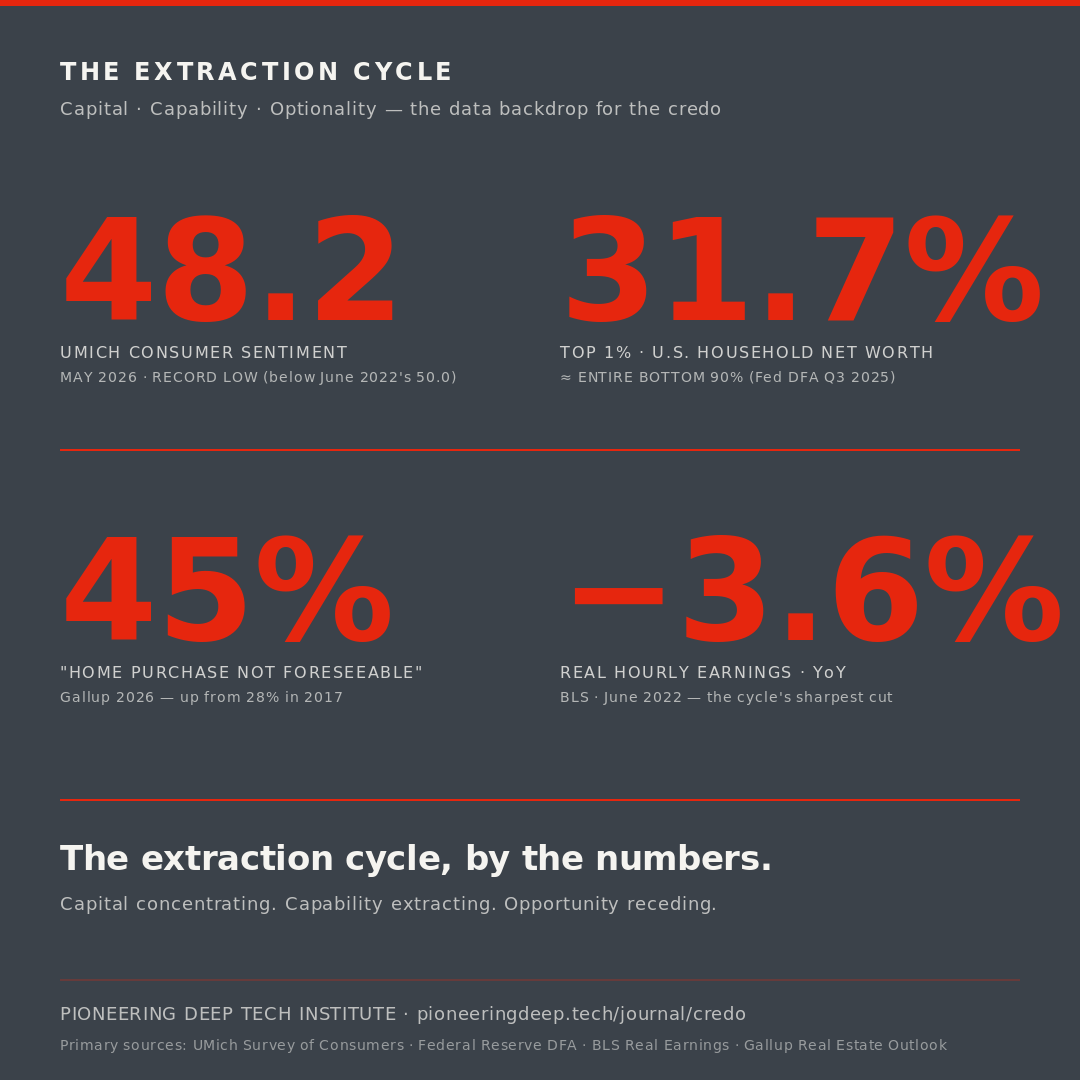
The Federal Reserve's Distributional Financial Accounts (Q3 2025) show the top 1% of households now holds 31.7% of household net worth — a share roughly equal to the entire bottom 90% of Americans combined. The series that tracks this convergence runs from 1989 to the present. The lines crossed in the mid-2010s and have not re-crossed since.
Gallup's most recent home-purchase outlook (April 2026) finds that 45% of non-homeowners say buying a home is not foreseeable for them — up from 28% in 2017. The other buckets are moving in the same direction.
This is not the story of a bad quarter. It is the longer cycle. Real wages stalling. Wealth concentrating. The horizon for ownership receding. People believing less in the institutions they were told to build through, and less in the future those institutions were supposed to deliver.
If half the people you grew up with do not think they can buy a home, and the other half think it will take a decade, the operating question shifts. It stops being "how do I get ahead." It becomes "what is the point of any of this." That is a hard question, and it is being asked in increasing volume across a country that until recently believed it was answered.
The cycle we're breaking
A friend of mine is among the longest-serving engineers at a mid-sized fraud-detection company. He has watched the same cycle four times: hire 100 engineers, ship a quarter, lay off 80, restart hiring twelve months later, repeat. The hires never reach the tenure where their judgment is load-bearing. The institution never accumulates the skill capture that a serious technical organization needs. The capability extracted from one quarter never returns; the company runs out of optionality.
The political rhetoric around this is that Americans do not have the talent — that we need to import workers to do what Americans will not. I have worked farm labor, cadaver-technician work, EMS, pyrotechnics, demolition, home construction, wildfire mitigation, manufacturing optimization, and an embarrassingly long list of technical positions. I would still be doing that work if a 38-ton excavator had not torn me in half and taken my right arm in May 2020. Americans want the work. They are being cut out of the authority to do it.
The lean and six-sigma toolkits exist because organizations atrophy under their own weight — the discipline only became formalized as a profession because companies stopped doing it natively. I went and got that certification (Lean Six Sigma Green Belt). My ISO 9001 Internal Auditor badge says I am credentialed to spot the same drift. None of that helps when the institution does not want to be told.
AI cannot be the beast of burden for all of this. A smaller pool of longer-tenured workers, asked to churn the output of three to five departed colleagues, produces worse work and burns out the workers who stayed. The downstream — fewer entry-level positions, fewer skills transferred, fewer new companies started, fewer vendors to source from, a smaller industrial base — is the part the optimizer cannot see from inside the cycle. Every actor treats the base as someone else's problem. Assuming someone else will maintain it is wrong.
I do not believe the solution is to strip wealth from people who have it. I do not believe it is prudent to lecture companies that are running this pattern. They are responding rationally to their incentives.
The cycle is the problem. We are calling it the extraction cycle: capital extracted from labor, capability extracted from institutions, optionality extracted from the future. Each turn reduces what the next turn has to work with.
How we operate differently
PDTI's answer is not a critique. It is a working example.
We lead by demonstrating, repeatedly, that a deep-tech company can go from concept to minimum viable product in 12–18 months — Geoffrey Moore's beachhead-strategy window for crossing the chasm — and that the company built that way can keep its intellectual property, keep its founders in control, and still pay its operating costs through a modest product-linked stake.
Four mechanical commitments:
- No IP capture. The founder keeps the company. We do not negotiate ownership of the work in exchange for capital. This is the structural feature that makes the rest of the model load-bearing. Stewardship of the work produces the rigor that produces the durability. When you own what you ship, you do it right.
- A portfolio, not a bet. Drink safety leads: a point-of-care test for a spiked drink, built on the same bench that reads kidney function. The kidney work is the proof point, not a second bet. Beyond that we stay open, because the right idea matters more than our roster.
- Concept to MVP in 12–18 months, with the beachhead behind it. Moore's framework is the operational discipline — pick the disciplined niche, prove the model there, refuse the temptation to chase the mainstream before the foundation is real. Most deep-tech ventures die because they try to be everywhere; we picked the beachhead before we started.
- 501(c)(3) governance. Three directors. Mission Statement binds that say what we will not do (capture IP) and what we will (community-benefit multiplier, modest product-linked stake to sustain exempt activities, sponsored scholarly work, expert-led education). Utah, since February 2022.
The first company is the proof of the model. Six weeks from empty repository to working production. Roughly $200 in API spend. Two cases in active production. Five engineers on the build (eight-person team overall), pre-payroll, who joined because they believed in what we were doing — not because we paid them to.
The credo
Utah 501(c)(3), since February 2022. EmberGraph Intel shipped April 2026. Three more in development. Three directors. A multi-domain engineering team that shipped before payroll because they believed in the institutional we.
We believe that inventors building societally beneficial and commercially viable deep technology should have access to capital, a place to build, and should benefit the most from their own hard work.
We believe the structural feature that makes deep tech durable is stewardship — the operator-owner relationship to the work — and that stewardship is what produces the rigor that produces the company.
We will not capture IP from founders. We will not negotiate the bargain that ate the laboratory my mentor built. We will not lecture the institutions running the extraction cycle. We will demonstrate, repeatedly, that there is another way.
We will be selective in what we sponsor — favoring projects with a clear community-benefit multiplier. We will conduct and sponsor scholarly research. We will deliver expert-led education so practitioners, policymakers, and the public can better understand and govern emerging technologies.
This is what we built. This is why.
References:
- University of Michigan Survey of Consumers — Consumer Sentiment Index, May 2026 release; FRED series UMCSENT
- U.S. Bureau of Labor Statistics — Real Earnings monthly release; historical real-wage troughs at June 2008 / August 2011 / June 2022
- Federal Reserve Distributional Financial Accounts (DFA), Q3 2025 release — household net worth share by percentile
- Gallup — Real Estate Outlook surveys, March 2017 + April 2026 — non-homeowner home-purchase horizon question
- Geoffrey A. Moore, *Crossing the Chasm, 3rd Edition: Marketing and Selling Disruptive Products to Mainstream Customers* (HarperBusiness, 2014). ISBN 978-0-06-229298-8.