
Andrew Piskadlo
CEO & President · Managing Director, EmberGraph Intel
About
Pioneering Deep Tech Institute
Turn scientifically valid deep-tech ideas into launchable companies. PDTI gives founders the resources, shared equipment, and execution support that bridge basic science to useful invention for public benefit.
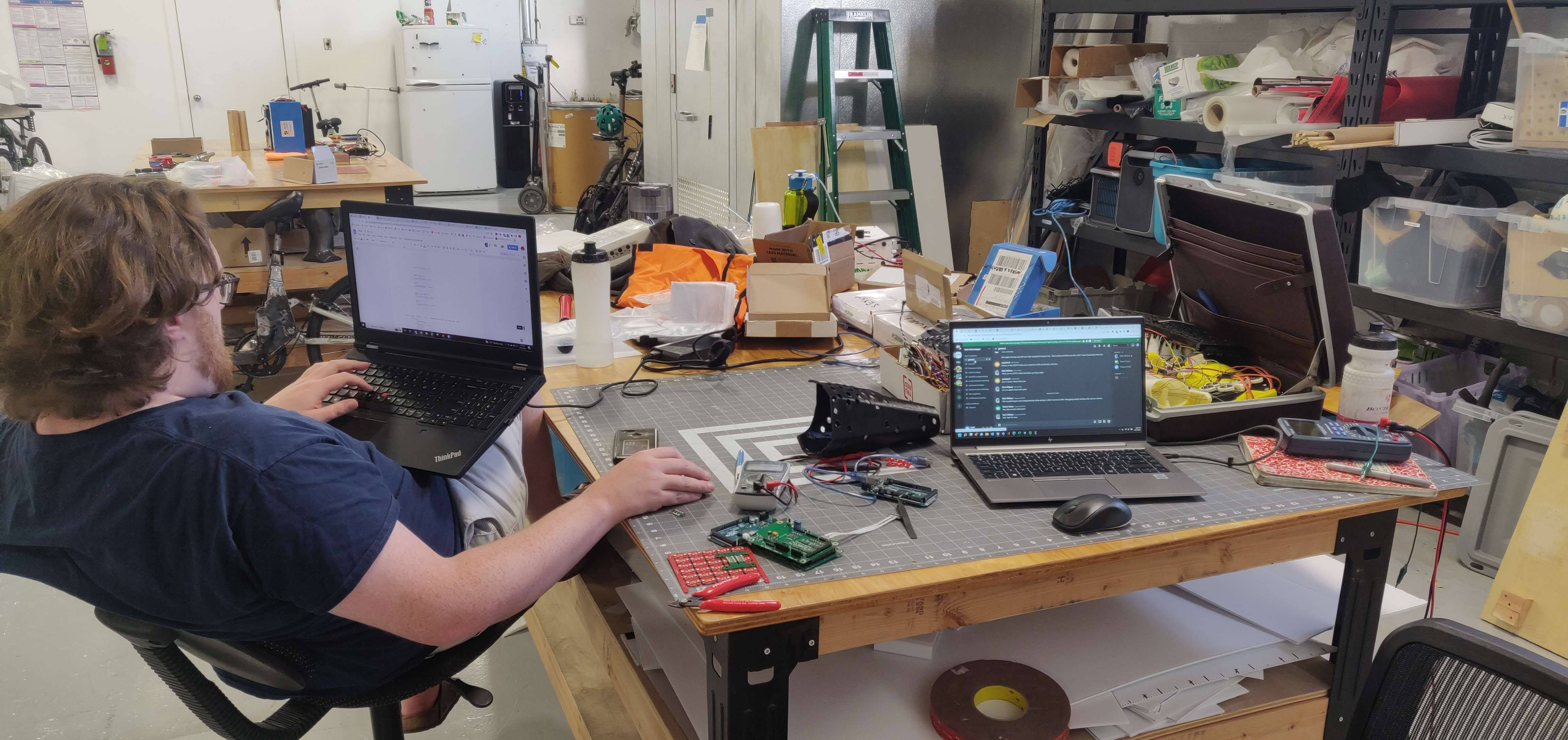
A Utah 501(c)(3) since February 2022. Three directors, a multi-domain engineering team, and one company already shipped.
About
Deep tech is convergence. Multiple disciplines forced into one product. No single discipline alone can ship it. PDTI exists to make convergence happen on purpose.
We operate across seven capability clusters. Each PDTI program spans the clusters it needs. Founder-aligned. Zero equity, no IP capture, and a modest product-linked royalty that recycles into the next builder.
We build hard things. Real things. Things that employ people and build into the American dream. The Credo is the longer answer: the mentor whose company was hollowed out, the extraction cycle we named, and the bargain we will not offer.
Each program assembles a discipline-mix that produces a product no single discipline alone could ship. EmberGraph Intel is the first company built through Zero to MVP. See the seven clusters in detail below, or apply if you build.
Our mission
We're a nonprofit that helps inventors turn a working prototype into a company they still own. We give them the space, the capital, and the manufacturing help to get across the last mile, and we keep no IP.
Our full mission was adopted by Board Resolution Exhibit C and signed 2025-12-28. It governs our filings and grant materials.
Capability
PDTI's operational substrate organizes into seven capability clusters. Each cluster spans owned core, partner-network access, and external contract relationships. Programs traverse the clusters they need.
High-performance compute, graph intelligence, and signal processing in service of evidence and decisions. EmberGraph Intel, the first company built through Zero to MVP, sits here.
Industrial robotic systems, computer vision for manufacturing, peripheral nerve interfaces, embedded control. Where physical work meets real-time decision.
The substrate under everything physical PDTI builds. Composites, biomaterials, semiconductor materials, casting polymers, characterization labs. Cross-cuts mining, water, and manufacturing access.
Point-of-care diagnostics, biosensors, microfluidic continuous-test platforms, drug delivery, synthetic chemistry. Real medicine for real people.
Analytical instrumentation across optical, RF, acoustic, and environmental modalities. Capture what's there. Turn it into something you can act on.
Power systems engineering. Nuclear-led generation, electrochemistry and battery work, grid hardware, advanced propulsion. The power American industry needs to win this decade.
Flight hardware, mission instrumentation, space-medicine diagnostics. The hardest engineering on the hardest schedule. Standup in 2027-2028 via existing alumni network.
How people work with us
Someone makes it. Someone pays for it. Someone supplies it. Someone tells people it exists. Each brings something specific and each gets something specific. We tell you fast if the fit is wrong, and we point you somewhere better when it is.
Builder
Bring the prototype. Keep the company.
Funder
Bring capital. Switch on capacity every builder after reuses.
Supplier
Bring capability. Get mission-aligned pipeline.
Amplifier
Bring audience. Get work that survives scrutiny.
You may be more than one of these, and most of our best relationships are: a supplier who also advises, a funder who also opens a door. Not sure where to start? Start with the builder form and say so. Mismatched fit goes to a better home elsewhere, and we tell you fast.
Output, not plans
Companies are not the only thing that leaves this institute.
The PDTI Journal is live and publishing. The Credo, long-form explainers, and an expert-interview series, all written to make deep-tech development, regulatory pathways, and emerging-technology governance legible to people who do not build for a living.
On the research side, our urinary collagen IV and eGFR correlation methodology for early chronic kidney disease detection is written up and under peer review.
The structural differentiator
Every conventional accelerator captures equity and often IP at terms that benefit the accelerator over the founder. PDTI is built the other way.
Stated as one sentence, the way we say it everywhere: zero equity, no IP capture, and a modest 3% product-linked royalty that recycles into the next builder, capped at 2x our cost, with a five-year sunset.
The operating consequence: a deep-tech founder with a working prototype and the right community-benefit profile can graduate through PDTI to a working MVP without forfeiting ownership of what they built.
2022 → today
Pioneering Deep Tech Institute was founded as Utah Research Institute (URI) in February 2022. URI received its 501(c)(3) determination from the IRS on 2022-02-25.
From 2023 through 2025, URI conducted research, developed methodology, and built the team and capability that underwrite the incubator model. In December 2025 the Board adopted the current mission, organizational structure, and public name. The state-level name change took effect at the same time. Under the original EIN, all records remain continuous.
EmberGraph Intel, the first company built through Zero to MVP, shipped in April 2026 as the operating proof. PDTI's operational substrate organizes into seven capability clusters. Each program spans the clusters it needs.
Feb 2022
URI founded; 501(c)(3) IRS effective
2023 to 2025
Research & methodology
Dec 2025
Renamed PDTI; mission adopted
Apr 2026
First company shipped: EmberGraph Intel
May 2026
Seven-cluster taxonomy locked
2026+
Additional companies in development
First company build · EmberGraph Intel · 6 weeks · March to April 2026
Shipped on the PDTI operating model. Proof the model is repeatable, founder-aligned, no IP capture.
Utah 501(c)(3) nonprofit
PDTI is governed by a Board of Directors with active oversight of mission alignment, financial stewardship, and program-level decisions.
CEO & President · Managing Director, EmberGraph Intel

Chief Technology Officer & Vice President · Co-founder

Secretary · Co-founder
Pioneering Deep Tech Institute is a Utah 501(c)(3) nonprofit organized for charitable, scientific, and educational purposes. PDTI was founded as Utah Research Institute (URI) in February 2022, with 501(c)(3) status effective 2022-02-25 per IRS determination. The state-level name change to Pioneering Deep Tech Institute was effective December 2025. Under the original EIN, all records remain continuous and in good standing.
Direct inquiries to info@PioneeringDeep.Tech.
Where to next
Routes by intent. Whether you're building, partnering, governing, or reading.

info@PioneeringDeep.Tech
© 2026 Pioneering Deep Tech Institute (PDTI) . All rights reserved.
Stay up to date on the latest developments at PDTI and Deep Tech